Machine Learning
Healthcare
Deep Learning
Explainable AI (XAI)
Computer Vision
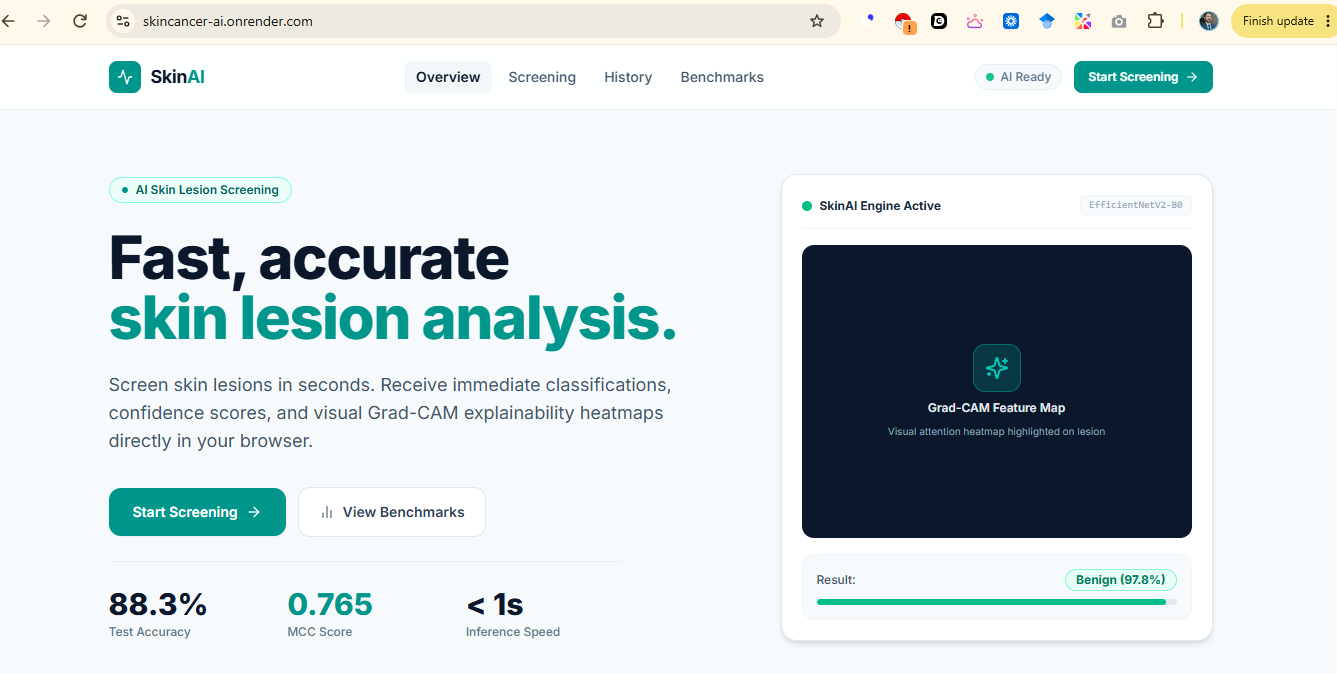
🚀 SkinAI – Explainable AI Skin Lesion Screening Platform
"A full-stack, deep-learning-powered skin lesion screening platform using EfficientNetV2-B0 and Explainable AI (Grad-CAM) to classify dermoscopic images, visualize model attention, and generate automated PDF screening reports. Achieved 88.33% accuracy on a 660-image test cohort."
Project Overview & Architecture
SkinAI – Explainable AI Skin Lesion Screening Platform
SkinAI is a full-stack, deep-learning-powered skin lesion screening and clinical decision-support application designed to demonstrate how Computer Vision, Deep Learning, and Explainable AI can be applied to dermatological image analysis.
The platform allows users to upload dermoscopic skin lesion images and receive AI-generated classifications into two categories: Benign and Malignant.
Powered by an EfficientNetV2-B0 deep learning model, SkinAI combines image classification, probability-based predictions, visual explainability, and automated PDF report generation within an interactive web application.
Project Overview
Traditional image classification models often operate as black boxes, providing predictions without clearly illustrating which visual features influenced their decisions.
SkinAI addresses this interpretability challenge by integrating Grad-CAM (Gradient-weighted Class Activation Mapping), allowing users to visualize model activation regions alongside the original dermoscopic image.
The platform combines a trained deep learning model with a modern full-stack architecture to deliver an interactive skin lesion screening experience.
Key Features & Capabilities
1. Deep Learning-Based Image Classification
- Analyzes uploaded dermoscopic images.
- Classifies skin lesions into Benign or Malignant categories.
- Provides prediction confidence scores and probability distributions.
- Uses EfficientNetV2-B0 as the primary production model.
- Includes a baseline CNN fallback model.
2. Explainable AI with Grad-CAM
- Generates visual heatmaps highlighting important image regions.
- Identifies spatial activation patterns influencing model predictions.
- Overlays activation maps onto original dermoscopic images.
- Helps users interpret model behavior rather than relying solely on classification output.
3. Interactive Image Visualization
- Side-by-side comparison of original and Grad-CAM images.
- Interactive split-slider comparison.
- Visual exploration of model activation regions.
4. Automated PDF Screening Reports
- Generates downloadable PDF screening reports.
- Includes prediction categories and confidence indices.
- Supports patient reference metadata.
- Incorporates Grad-CAM visualizations into generated reports.
5. Screening History Management
- Maintains a session-scoped screening history.
- Supports searching and filtering previous classifications.
- Provides individual screening record details.
- Supports record deletion and associated file cleanup.
6. Multi-Model Evaluation
- Evaluates different deep learning architectures.
- Compares a custom CNN, EfficientNetV2-B0, and Vision Transformer (ViT-B16).
- Provides comparative performance metrics.
- Selects EfficientNetV2-B0 as the production model based on the reported evaluation results.
Selected Production Model: EfficientNetV2-B0
EfficientNetV2-B0 achieved 88.33% classification accuracy and a reported ROC AUC of 0.9489 on the evaluation cohort. It was selected as the primary model, with native convolutional feature maps supporting Grad-CAM explainability.
The reported inference latency was 1.8 ms, compared with 8.2 ms for ViT-B16, under the project's benchmark conditions.
These are model evaluation results, not evidence of clinical validation or real-world diagnostic accuracy.
Engineering Highlights
This project demonstrates practical expertise in:
- Deep Learning and Computer Vision.
- CNN architecture development.
- Transfer learning with EfficientNetV2.
- Vision Transformer benchmarking.
- Explainable AI and Grad-CAM.
- Model evaluation and performance optimization.
- FastAPI backend development.
- React and TypeScript frontend engineering.
- Docker-based deployment.
- REST API design and integration.
Project Objective
The objective of SkinAI is to demonstrate how deep learning and explainable AI can support dermatological image screening by combining automated image classification with visual interpretability and structured reporting.
Clinical Safety Disclaimer: SkinAI is an experimental AI-based screening and decision-support platform. Its predictions and Grad-CAM visualizations are not autonomous medical diagnoses. Results must not be used as a substitute for professional medical assessment, dermoscopic examination, or biopsy. All findings require evaluation by a qualified healthcare professional.
Key Capabilities & Features
- ✓ Real-Time Skin Lesion Image Classification
- ✓ Grad-CAM Explainable AI Visualization
- ✓ EfficientNetV2-B0 Deep Learning Model
Technologies & Tools
Python
FastAPI
Deep Learning
Computer Vision
Vision Transformer
Explainable AI